

Most students do not struggle because they are incapable. They struggle because they get stuck, and the help they need is not available at the moment they need it.
Maybe they missed one key class. Maybe they did not feel comfortable asking a “basic” question in front of others. Maybe office hours were full. Maybe they are balancing work, family, and coursework and simply cannot keep up with the pace.
That gap between “I’m stuck” and “I got help” is where motivation drops, confusion compounds, and outcomes suffer.
StudyBuddy™ is built to close that gap.
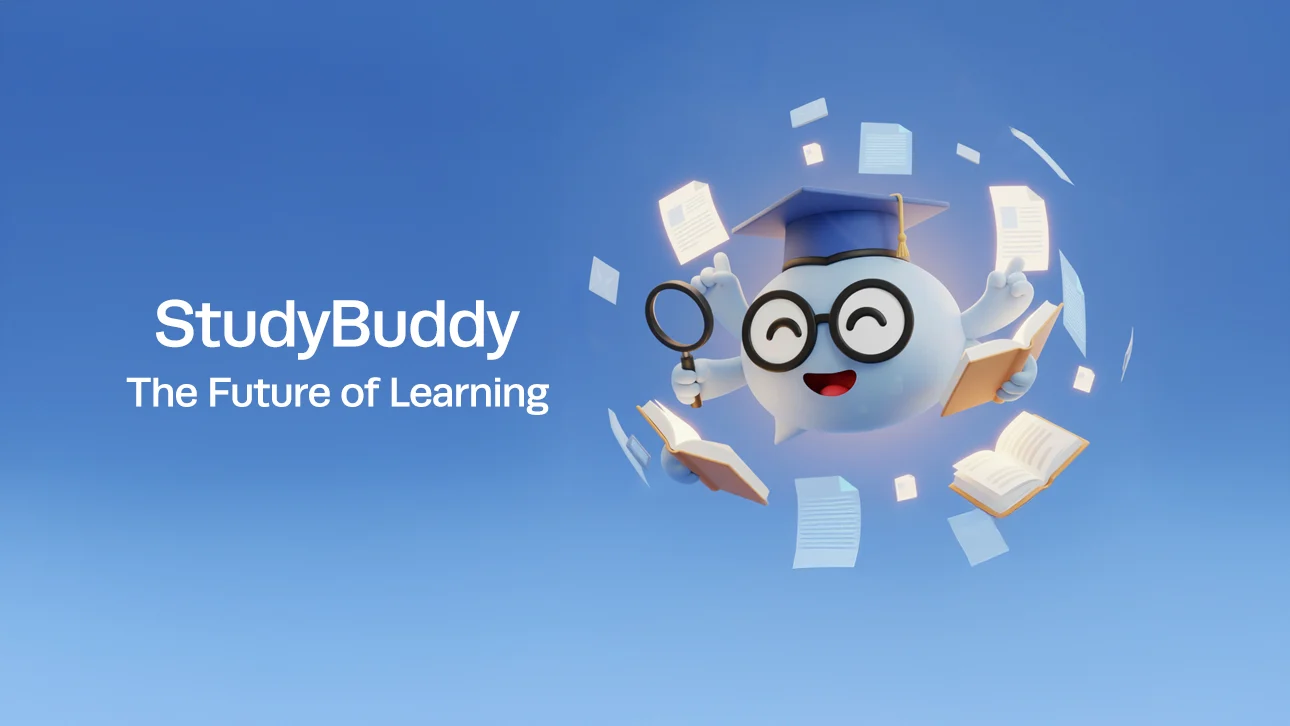
It is an AI tutor and learning assistant that lives inside the LMS, understands your course materials, and guides students using a Socratic style that builds real comprehension. The goal is not to replace instructors. The goal is to scale timely academic support, reinforce critical thinking, and give faculty and academic teams better visibility into where students are struggling.
Why AI tutoring is accelerating now
AI in education is growing fast for one simple reason: institutions need a way to deliver more support without endlessly expanding staff hours.
Across higher education, student expectations have changed. They want answers quickly. They want support outside business hours. They want learning to fit into real life.
At the same time, institutions face real constraints: limited tutoring capacity, overloaded faculty, and uneven student preparedness. When support does not scale, outcomes become uneven too.
AI tutors address this as a capacity system. Not as a novelty.
What an AI tutor actually is (and what it is not)
An AI tutor is not “a chatbot that answers questions.”
A real AI tutor is designed around learning outcomes. It helps students understand concepts, asks follow-up questions, adapts explanations, and guides the student toward the answer rather than simply handing it over.
The difference matters because generic AI tools can be fast but unreliable for learning environments. They are not course-aware by default. They can drift from the curriculum. They can create academic integrity risks. And they typically do not provide the controls and visibility institutions need.
StudyBuddy™ is designed specifically to solve those issues.
What makes StudyBuddy™ different from generic AI chatbots
StudyBuddy™ is built on Bay6’s Connect6 platform and is purpose-built for higher education environments.
- Course-aware by design
StudyBuddy™ is trained on your course materials so the guidance stays aligned with your curriculum, not generic internet content. - Socratic tutoring that builds understanding
Instead of acting like an “answer machine,” StudyBuddy™ guides students with prompts and questions that encourage reasoning and retention. - LMS-integrated with course access security
It is designed to operate inside the LMS and respect enrollment and role-based access controls. - Controlled web search with citations and sources
When an answer is not found in the approved knowledge base, StudyBuddy™ can augment using controlled web references and provide source-cited responses from approved references. - Faculty-friendly controls and visibility
Academic teams can review transcripts, see answered versus unanswered questions, track usage trends, and use feedback to improve content quality. - Built for accessibility and reach
Bilingual support (English and Spanish today), plus voice-enabled input and output to support different learner needs.
The student problems StudyBuddy™ solves, without adding staff hours
Students get stuck outside class hours
Learning does not happen neatly between 9 and 5. StudyBuddy™ provides on-demand help inside the LMS so students can keep moving.
Students hesitate to ask questions publicly
Many students avoid asking questions out of fear of judgment. StudyBuddy™ gives them a private, low-pressure way to ask, retry, and clarify.
Students need explanations that match their level
A single lecture explanation does not work for everyone. StudyBuddy™ can re-explain in simpler language and guide understanding step-by-step.
Students need consistent support across large cohorts
In large classes, consistency is hard. StudyBuddy™ provides consistent academic guidance at scale, while instructors retain oversight through controls and transcripts.
How StudyBuddy™ works
StudyBuddy™ is designed to fit into existing learning operations, not force new workflows.
- Integrates with the LMS for easy deployment
- Uses secure API sync for student information and access controls
- Learns from course study materials provided by academic teams
- Delivers support inside the LMS, where students already work
- Applies a Socratic tutoring style to build comprehension
- Uses controlled web lookups when appropriate, with accurate citations
This is the difference between “AI that feels impressive” and AI that is operationally usable in education.
What academic teams get (beyond the student experience)
A good AI tutor should not only help students. It should also improve visibility for academic teams.
StudyBuddy™ includes an analytics portal designed for academic teams to:
- Monitor usage patterns and engagement trends
- Review answered versus unanswered questions to identify gaps
- Access conversation transcripts for quality and governance
- Use student feedback to improve course materials and knowledge coverage
Over time, this creates a feedback loop where student friction points become visible and fixable.
Security, privacy, and institutional readiness
AI in education rises or falls on trust.
StudyBuddy™ is built with the controls institutions expect, including:
- Access control: governed by enrollment and role-based permissions.
- Data handling: designed to align with FERPA requirements
- Auditability: transparent through transcripts, logs, and admin reports
- Compliance: SOC 2 Type II certified and FERPA compliant. This matters because institutions need governance, not just features.
A practical way to pilot StudyBuddy™ (without boiling the ocean)
If you want results, start focused.
A strong pilot approach typically looks like:
- Pick 3 to 5 courses with high enrollment or high drop-off risk.
- Ingest approved course materials and define what “approved references” means.
- Set clear measurement targets (adoption, deflection, student satisfaction, unanswered-question reduction).
- Review transcripts weekly and tune content coverage with faculty input.
- Expand based on evidence, not enthusiasm.
When you treat AI tutoring as a measurable system, you get real outcomes.
The future of tutoring is blended
AI tutors will not replace educators. But they will change the baseline expectation of support.
- Instant help inside the LMS
- Explanations tailored to their understanding
- Accessible, bilingual experiences
- Guidance that teaches them how to think, not what to copy. StudyBuddy™ is built for that future.
Talk to us. Let’s build what moves the needle.
Book a Demo