
August 2, 2026, is not a date for legal teams to circle quietly. It is a deadline that will expose whether an enterprise can explain where AI is used, what decisions it affects, what data it touches, and who is accountable when something goes wrong.
For U.S. enterprises that sell into Europe, serve European customers, process EU data, or use AI inside regulated workflows, the practical risk is simple. A policy document will not be enough. The operating model needs evidence. The evidence needs to be available before auditors, customers, partners, or regulators ask for it.
This is where many AI programs are vulnerable. The enterprise has pilots. It has copilots. It has business teams using AI in pockets. What it often does not have is one shared view of systems, use cases, risk levels, approvals, human oversight, data paths, and exception handling.
What regulated enterprises should fix first
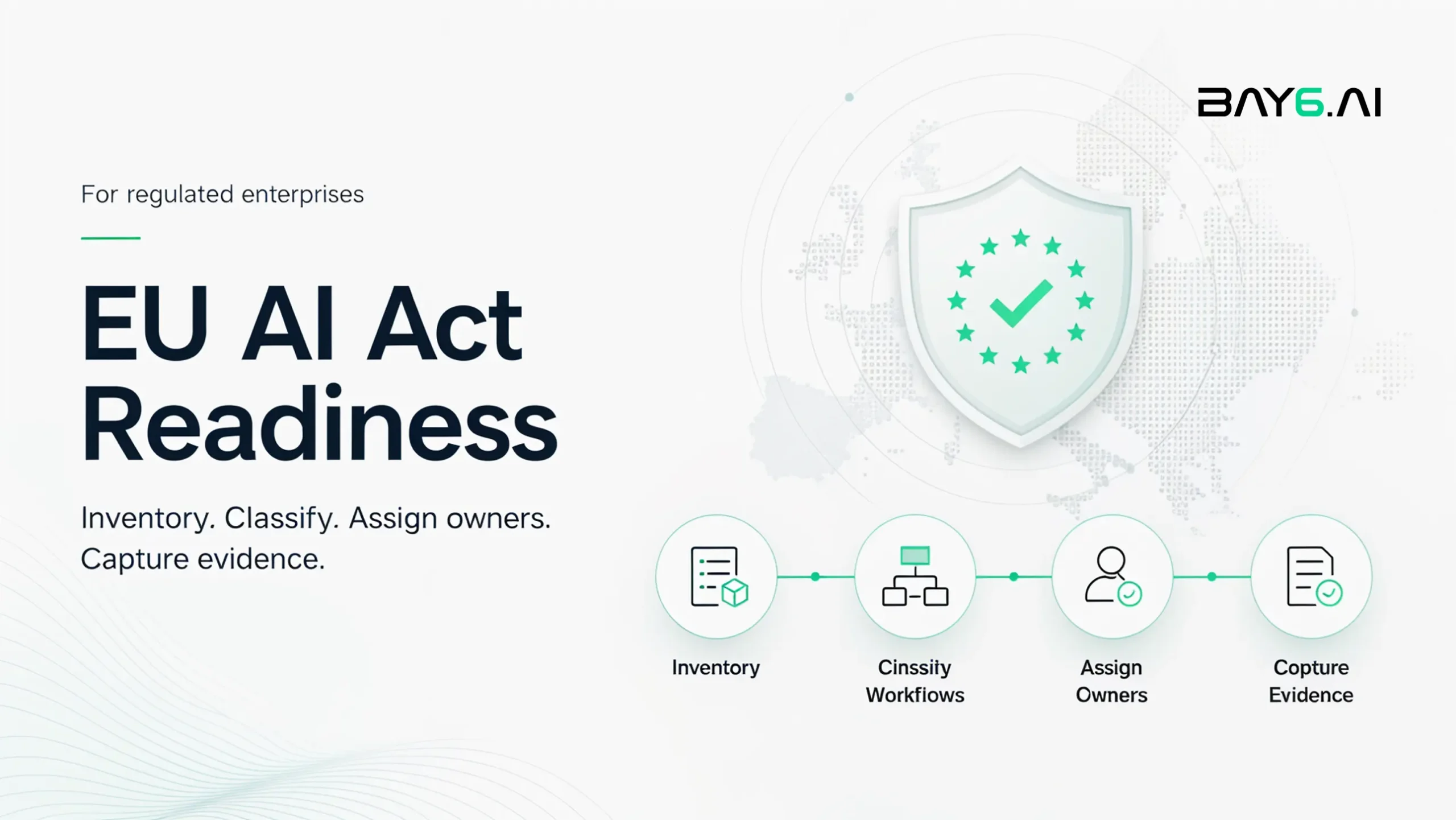
The first step is AI inventory. Most organizations do not know how many AI touchpoints exist across customer service, claims, underwriting, lending, admissions, document review, marketing, analytics, HR, and internal knowledge work. Shadow AI is not a cultural problem. It is an audit problem.
The second step is workflow classification. Do not classify only the model. Classify the business decision. An AI assistant answering a generic question is one category. An AI system influencing eligibility, pricing, fraud review, student support, credit decisions, legal triage, or claims escalation is another. Risk lives inside the workflow.
The third step is evidence design. Every high-impact AI process should leave an operational trail: input source, decision path, confidence signals, human review point, override history, final action, and downstream outcome. If the enterprise cannot reconstruct the decision, it does not control the decision.
Why policies fail without workflow controls
Most AI governance documents are written like procurement checklists. They define acceptable use, banned use, data rules, and approval steps. That matters. But governance that stays outside the workflow becomes decorative. It looks good in a committee deck and disappears during daily work.
AI governance needs to sit inside the workflow itself. That means identity-based access, role-specific permissions, data boundaries, approval routing, audit logs, escalation logic, and monitoring tied to business outcomes. The enterprise needs controls that work when volume spikes and employees are moving fast.
The hard truth is that regulated enterprises do not fail because they lack AI enthusiasm. They fail because nobody owns the gap between the model output and the business action.
A 60-day readiness agenda
Start with a working inventory of AI systems and AI-enabled workflows. Include vendor tools, internal tools, analytics models, chat interfaces, copilots, automation rules, and business-unit experiments. If the team cannot find it, it cannot govern it.
Next, build a risk map by workflow. Separate informational use cases from action-driving use cases. Identify areas where AI affects access, eligibility, pricing, financial outcomes, student support, legal review, claims handling, customer rights, or regulatory reporting.
Then assign accountable owners. Every AI workflow needs a business owner, a technical owner, a risk owner, and an escalation path. Committees do not operate workflows. Named owners do.
Finally, put evidence capture into production. The enterprise should be able to show what happened, why it happened, who reviewed it, and what changed after review. That is the line between aspiration and readiness.
The Bay6 AI position
Bay6 AI treats AI governance as an operating layer, not a binder. Enterprises need AI that fits existing systems, respects controls, acts with context, and produces measurable outcomes without creating a new risk surface.
For regulated organizations, the advantage will go to teams that can move quickly while preserving evidence. That requires workflow design, governance design, and AI deployment design to happen together. Separating them is how expensive pilots become expensive liabilities.
The next phase of enterprise AI belongs to organizations that can prove control at the same time they prove value.
FAQ’s
- What should enterprises do before the August 2, 2026 EU AI Act deadline?
Enterprises should build an AI inventory, classify workflows by risk, assign accountable owners, and capture evidence inside daily operations. The goal is to show where AI is used, what decisions it affects, who reviews it, and how outcomes are controlled.
- What should enterprise buyers measure before deploying AI in this workflow?
Buyers should measure more than model accuracy. They should evaluate data access, workflow impact, human review, exception handling, audit logs, and measurable business outcomes before approving AI for regulated use.
- How can AI reduce operational friction without removing human accountability?
AI can summarize information, route work, flag risks, and recommend next steps. Human accountability stays intact when approvals, overrides, escalation paths, and audit trails remain built into the workflow.
Book an AI governance readiness review with Bay6 AI.
Book a Demo