
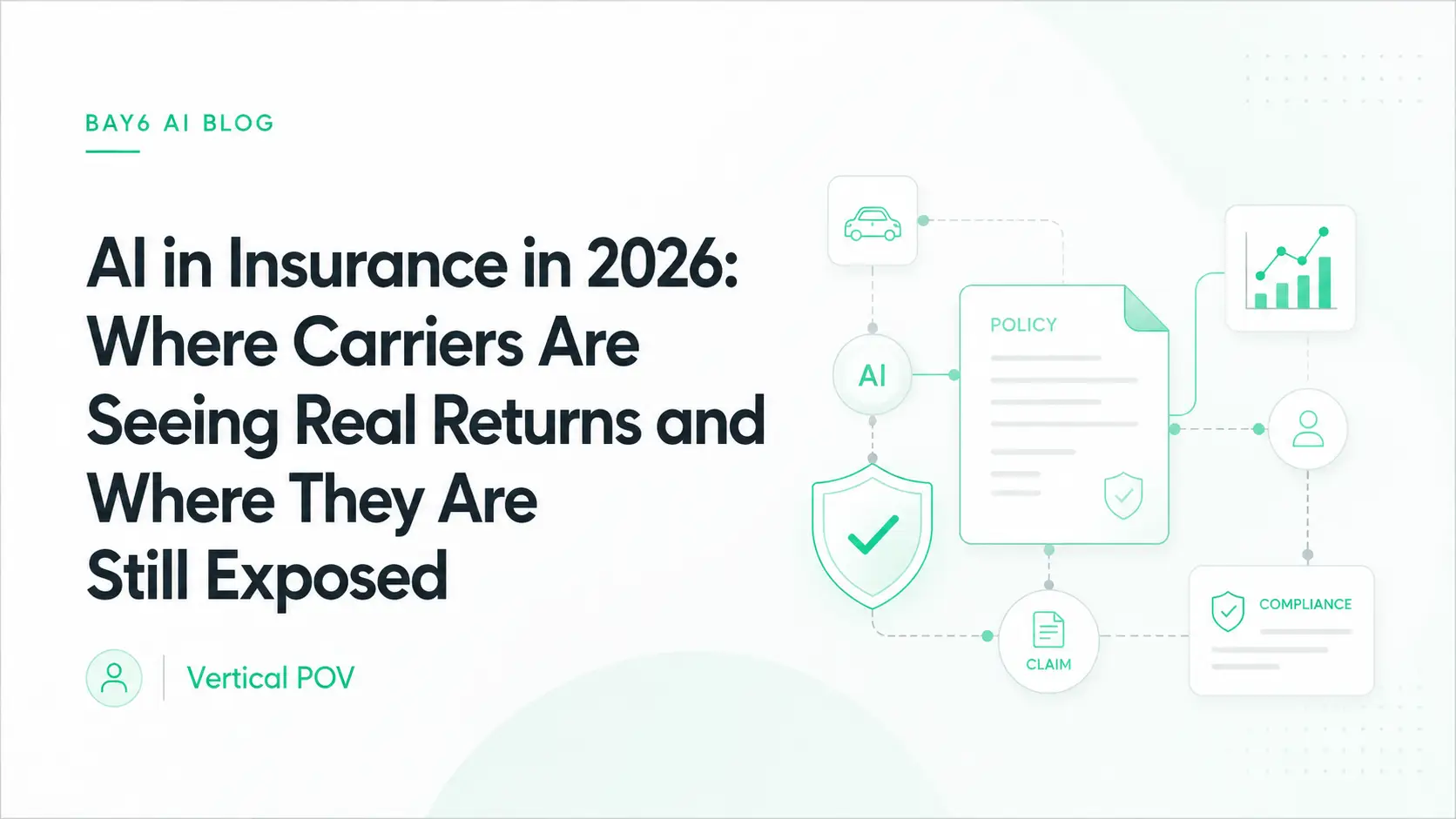
Insurance carriers are no longer asking whether AI can help. They are asking where it can produce return without weakening trust, fairness, compliance, or customer experience.
That is the right question. Insurance is built on judgment. Risk selection, pricing, claims handling, policy servicing, fraud detection, and renewal management all depend on context. AI can improve the operating model, but only if it is attached to the right controls.
The winners in 2026 will not be carriers with the most AI experiments. They will be carriers that connect AI to measurable workflow outcomes: faster claims resolution, better triage, lower servicing cost, cleaner underwriting support, stronger fraud prioritization, and fewer avoidable escalations.
Where carriers are seeing returns
Claims is the obvious first area. High volumes, repetitive intake, missing documentation, routing decisions, status inquiries, and escalation logic create immediate value opportunities. AI can classify claims, collect context, answer routine policy questions, detect missing information, and prepare adjusters for review.
Policy servicing is another high-value area. Customers ask the same questions about coverage, renewals, endorsements, billing, documents, and claim status. Connect6-style self-service can reduce avoidable contact volume while still handing complex issues to human agents with full context.
Underwriting support is where Model6-style predictive intelligence becomes important. Historical data can expose patterns that help teams prioritize review, identify risk signals, and support faster decisions without removing human accountability from complex cases.
Fraud and anomaly detection remain strong use cases, but they must be handled carefully. AI should help prioritize attention, not create unexplained black-box conclusions that downstream teams cannot defend.
Where carriers remain exposed
The first exposure is data fragmentation. Carrier data is often spread across policy administration systems, claims platforms, billing tools, CRM systems, document stores, spreadsheets, and partner networks. AI cannot drive reliable outcomes if the operating context is scattered.
The second exposure is governance that does not reach production. Many insurers have AI principles. Fewer have controls embedded into claims, underwriting, pricing, servicing, and exception workflows.
The third exposure is customer trust. A fast answer that is wrong, incomplete, or inconsistent can damage confidence quickly. In insurance, customers usually contact the carrier when something matters. Accuracy is not optional.
The fourth exposure is measurement. If AI impact is reported as activity, adoption, or novelty, leaders will lose patience. The board needs operating metrics tied to cost, cycle time, leakage, retention, quality, and service outcomes.
What an insurance-ready AI operating model needs
It needs workflow-specific governance. Claims AI should not be governed exactly like marketing content AI. Underwriting AI should not be governed exactly like customer-service AI. The control model must reflect the workflow risk.
It needs human review where judgment matters. The goal is not to remove expertise. The goal is to remove low-value manual work so experts focus on the cases where judgment actually changes the outcome.
It needs evidence. Carriers should be able to explain what AI saw, what it recommended, what action was taken, who reviewed it, and what outcome followed.
It needs continuous monitoring. Claims patterns, risk pools, fraud behaviors, customer expectations, and regulatory scrutiny change. AI workflows must be reviewed as living systems.
The Bay6 AI position
Bay6 AI is well-positioned for insurance because the problem is not just automation. It is workflow understanding. Insurance needs AI that can read context, act inside established systems, predict likely outcomes, and support controls that stand up to review.
PolicyBuddy™ can support policy understanding. Connect6 can reduce routine service volume. Model6 can support predictive intelligence. Forge6 can help carriers build roadmaps, governance models, and custom solutions that connect AI to measurable business value.
The insurance AI opportunity is real. So is the operational exposure. The carriers that win will treat both facts as true at the same time.
Common Questions About AI Adoption in Insurance
- Where are insurance carriers seeing AI ROI in 2026?
Insurance carriers are seeing AI ROI in claims triage, policy servicing, underwriting support, fraud prioritization, and renewal workflows where AI can reduce manual work, improve routing, and speed up decisions
- What should enterprise buyers measure before deploying AI in this workflow?
Enterprise buyers should measure cycle time, service volume, exception rates, manual review effort, cost per transaction, escalation rates, accuracy, compliance quality, and customer experience impact.
- How can AI reduce operational friction without removing human accountability?
AI reduces friction by gathering context, flagging missing data, routing cases, preparing recommendations, and summarizing evidence while humans remain responsible for judgment-heavy or high-risk decisions.
Book an AI governance readiness review with Bay6 AI.
Book a Demo