

Higher education does not have an AI awareness problem. Students are already using AI. Faculty are reacting. Administrators are trying to create guidance. The next question is more practical: how should institutions use AI to improve the operations students depend on every day?
That conversation gets less attention than academic integrity, but it may be where institutions can move faster and show clearer value. Student service operations are full of repetitive questions, peak-cycle volume, fragmented information, and preventable friction.
Admissions. Financial aid. Registration. Course access. Holds. Transcripts. Academic calendars. Housing. Advising. IT support. Program requirements. Students need answers quickly. Staff are overwhelmed during the exact moments when service quality matters most.
Why experimentation is not enough
A chatbot placed on a website is not an AI operating model. A tutoring assistant in one course is not an institutional AI strategy. A faculty guideline is not a student-support workflow.
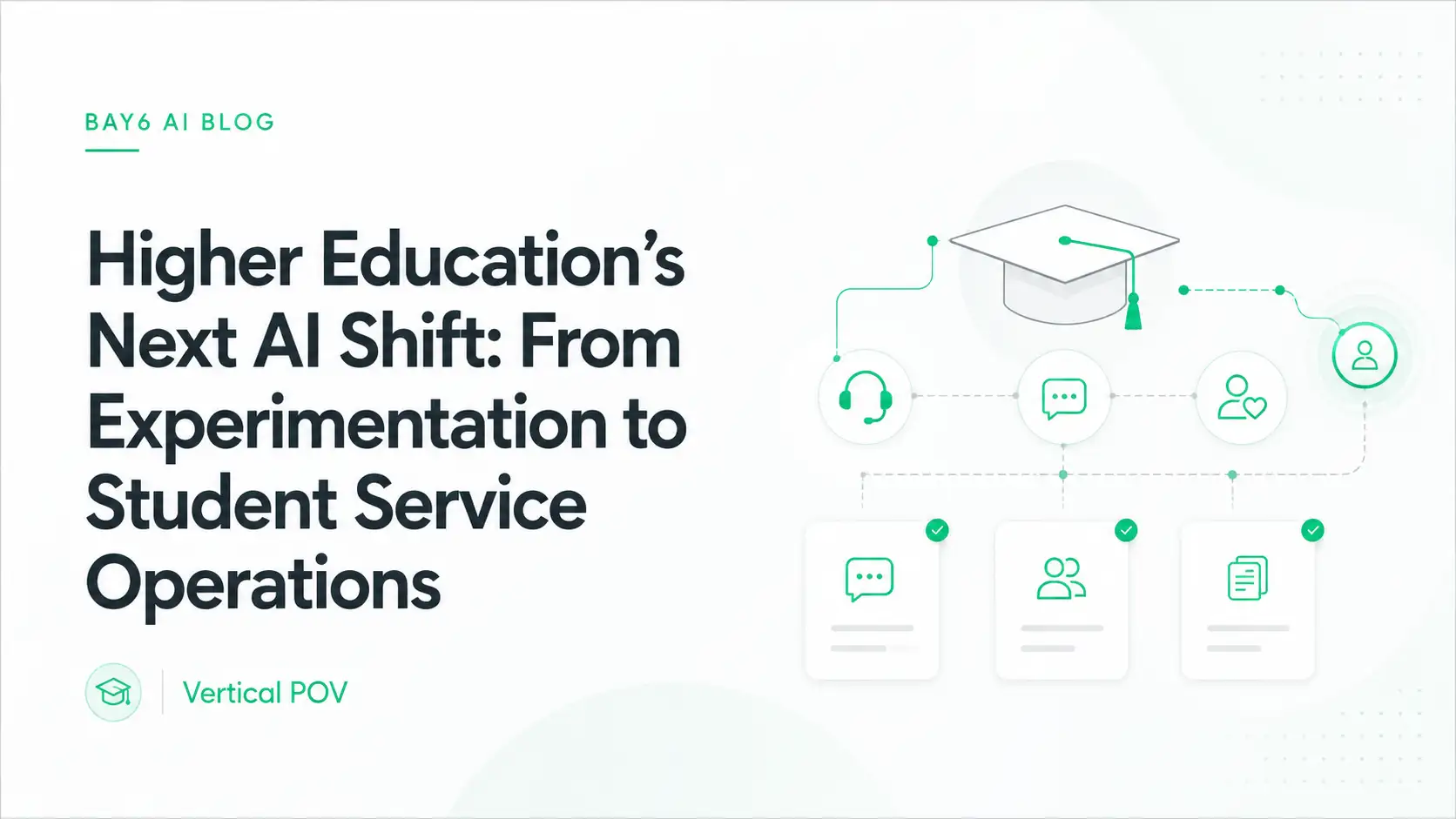
The next shift in higher education AI is from experimentation to operational design. Institutions need to decide which questions AI can answer, which systems it can reference, where it must escalate, how staff receive context, and how outcomes are measured.
Without that discipline, AI creates another layer of confusion. Students receive inconsistent answers. Staff distrust the system. Leadership cannot prove value. The implementation becomes a novelty instead of infrastructure.
The best initial use cases
Start with high-volume, low-risk, information-heavy workflows. Admissions deadlines, document requirements, application status, orientation details, registration support, calendar questions, and policy navigation are all strong candidates when connected to approved content.
Next, target service workflows where students need guided support but not a final academic decision. Financial aid document reminders, hold explanations, transcript steps, and escalation routing can reduce staff load without replacing human judgment.
Then consider learning support. StudyBuddy™-style AI tutoring can help students receive guided explanations, practice support, and academic assistance while preserving boundaries around doing the work for the student.
What responsible student-service AI requires
The first requirement is approved knowledge. AI should answer from content the institution controls, not from a general guess. This is especially important for policies, deadlines, program requirements, and financial information.
The second requirement is escalation. Students with sensitive, complex, or high-impact issues should not be trapped in automation. AI should hand off to staff with a clear summary and all relevant context.
The third requirement is accessibility. AI support should reduce friction for students who struggle with office hours, time zones, work schedules, transportation, or first-generation navigation of institutional processes.
The fourth requirement is measurement. Institutions should track containment, resolution quality, escalation rate, student satisfaction, response time, staff workload reduction, and repeated-question trends.
The Bay6 AI position
Bay6 AI is built for the practical side of higher education AI. StudyBuddy™ supports academic learning assistance. Connect6 can reduce repetitive student-service load. Forge6 can help institutions create a roadmap that protects governance and outcomes.
The institutions that win will not be the ones that simply allow AI. They will be the ones that make AI useful, bounded, and measurable inside the operations students actually experience.
Students do not need another portal. Staff do not need another queue. Institutions need AI that answers, routes, supports, and escalates with context.
FAQs
- How can higher education use AI in student service operations?
Higher education can use AI to answer repetitive student questions, route support requests, prepare staff summaries, and guide students through admissions, financial aid, registration, transcripts, housing, advising, and IT support. The best use cases start with approved institutional knowledge, clear escalation rules, and measurable outcomes. - What should enterprise buyers measure before deploying AI in this workflow?
Enterprise buyers should measure the current student-service baseline before deploying AI. Key metrics include inquiry volume, response time, resolution rate, escalation rate, repeated-question trends, student satisfaction, staff workload, peak-cycle support load, and service quality. These metrics make AI impact easier to prove after launch. - How can AI reduce operational friction without removing human accountability?
AI can reduce operational friction by handling routine questions, routing cases, summarizing context, and helping staff respond faster. Human teams should still own complex, sensitive, high-impact, or policy-dependent decisions, with AI escalating those cases instead of trying to resolve them alone
Talk to Bay6 AI about reducing repetitive student-service load?
Book a Demo