

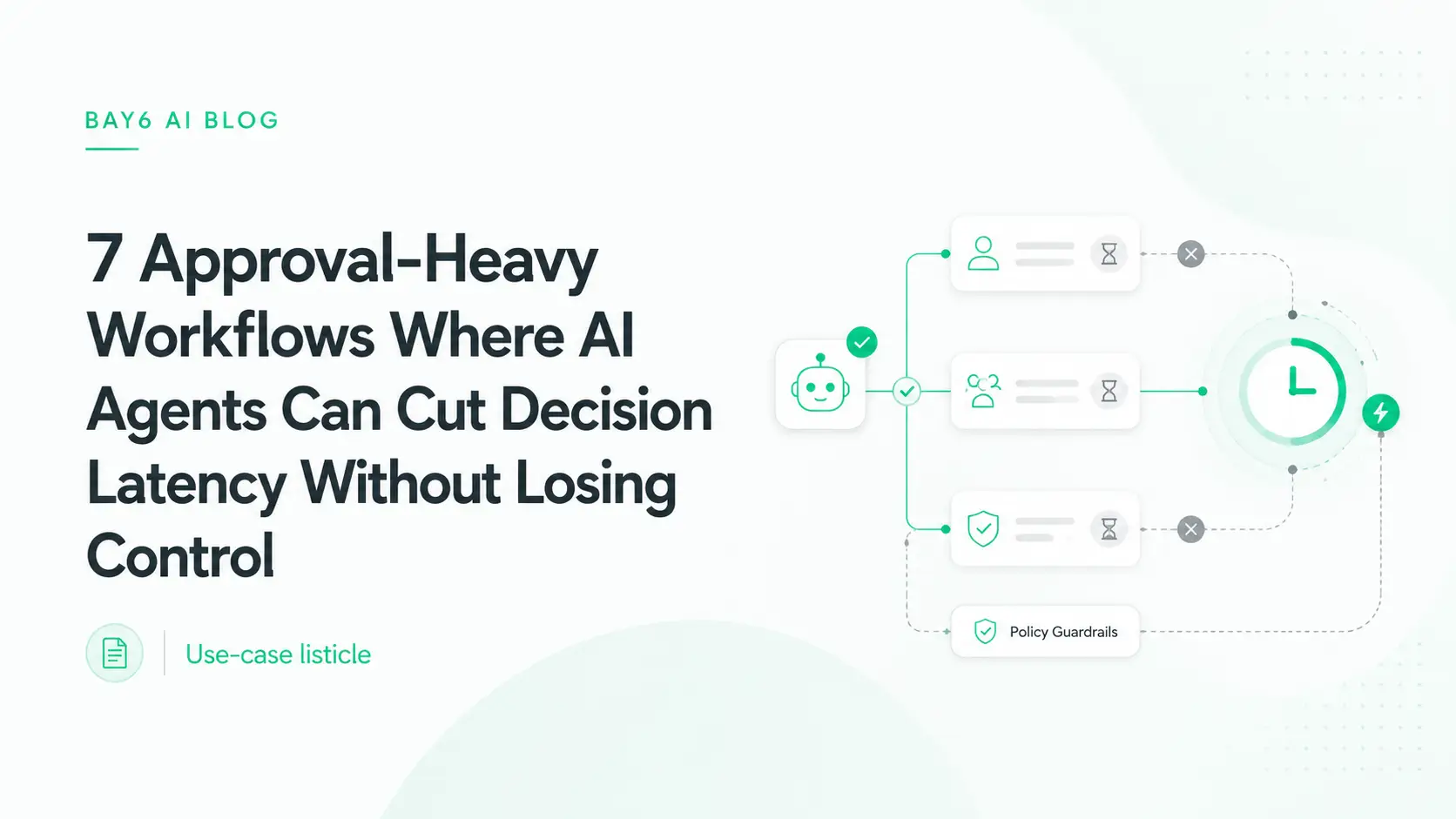
Approval-heavy workflows look responsible on paper. In practice, they often become expensive waiting rooms. A request sits in a queue. A reviewer needs context. A system has missing data. A policy needs interpretation. The business waits while people assemble facts that AI could have gathered in seconds.
The answer is not uncontrolled automation. That is how risk multiplies. The answer is governed AI assistance that prepares the decision, routes the exception, recommends the next step, and creates a traceable record for the human who owns the call.
For enterprise buyers, the question is no longer whether AI can help. The better question is where approval latency is damaging revenue, service quality, compliance, or employee capacity.
1. Claims triage and escalation
Insurance claims are full of routing decisions. Some are routine. Some need adjuster review. Some need fraud attention. Some need documents that customers already sent but staff still have to locate.
AI agents can classify incoming claim events, pull policy context, detect missing information, recommend routing, and flag cases that require human attention. The control point is clear: AI prepares and routes; humans decide on complex or sensitive outcomes.
The business impact is shorter cycle time, lower manual triage volume, and better use of expert adjusters.
2. Underwriting exceptions
Underwriting teams lose time when exceptions require context gathering across history, documents, appetite rules, prior decisions, and external signals. AI can assemble the decision package before an underwriter reviews it.
The agent should not replace underwriting judgment. It should reduce the time spent finding facts, comparing cases, and preparing the recommendation.
This is a strong AI fit because the process is high-value, repeatable, and dependent on structured decision discipline.
3. Lending and credit operations exceptions
Financial institutions deal with exceptions across credit, fraud, onboarding, servicing, and complaints. Each exception creates delay, customer friction, and operational cost.
Governed AI can route cases by policy, risk tier, customer segment, and missing information. It can also prepare reviewer notes and preserve evidence for audit trails.
The point is not faster risky decisions. The point is faster prepared decisions with clearer accountability.
4. Vendor onboarding and risk review
Procurement, legal, security, finance, and risk teams often touch the same vendor file. AI can read submissions, identify missing artifacts, classify risk, route approvals, and summarize open issues.
This reduces the back-and-forth that slows business teams while still keeping the control model intact.
It also creates better evidence for why a vendor moved forward, paused, or required extra review.
5. Compliance review and policy exceptions
Compliance teams are overloaded because everything feels urgent and everything claims to be unique. AI can help separate routine policy questions from exceptions that require expert judgment.
The agent can identify the relevant policy, summarize the request, propose the review path, and capture the final outcome. That turns compliance from a bottleneck into a controlled workflow partner.
The largest value is not only speed. It is consistency.
6. Student services escalation
Higher education teams handle recurring questions about admissions, registration, financial aid, academic calendars, holds, transcripts, forms, and course access. Staff should not spend peak-cycle hours answering the same first-level questions repeatedly.
AI can answer routine questions from approved content, collect missing context, and escalate complex cases to staff with a clean summary.
That protects student experience while reducing pressure on service teams.
7. Knowledge-base change approvals
Enterprise knowledge decays quickly. Policies change. Benefits change. Product details change. Program requirements change. If knowledge updates need approval, they create their own bottleneck.
AI can identify inconsistent content, draft update recommendations, route changes to the right owner, and flag downstream workflows affected by the update.
This matters because every AI system that depends on stale knowledge eventually becomes a confidence problem
The Bay6 AI position
Bay6 AI is designed for enterprises where AI must do more than answer questions. It needs to understand context, connect with systems, support decisions, automate safe actions, and hand off with full context when human judgment matters.
The best first AI use case is often not the flashiest one. It is the approval-heavy workflow where delay is measurable, patterns are repeatable, and controls are already understood.
Cut the waiting time. Keep the accountability. That is the operating standard enterprise AI needs.
FAQs
- Which approval-heavy workflows can AI agents improve?
AI agents can improve approval-heavy workflows such as claims triage, underwriting exceptions, lending reviews, vendor onboarding, compliance approvals, student service escalations, and knowledge-base change approvals.
- What should enterprise buyers measure before deploying AI?
Enterprise buyers should measure approval cycle time, queue volume, exception rates, reviewer workload, rework, wait times, and audit documentation quality before deploying AI agents.
- How can AI reduce friction without removing accountability?
AI reduces friction by gathering context, identifying missing data, routing requests, and preparing reviewer notes while humans remain responsible for complex or high-risk decisions.
Book an AI governance readiness review with Bay6 AI.
Book a Demo