


AI tutoring works better when students do not have to leave the course to get help.
Why the LMS is the right control point
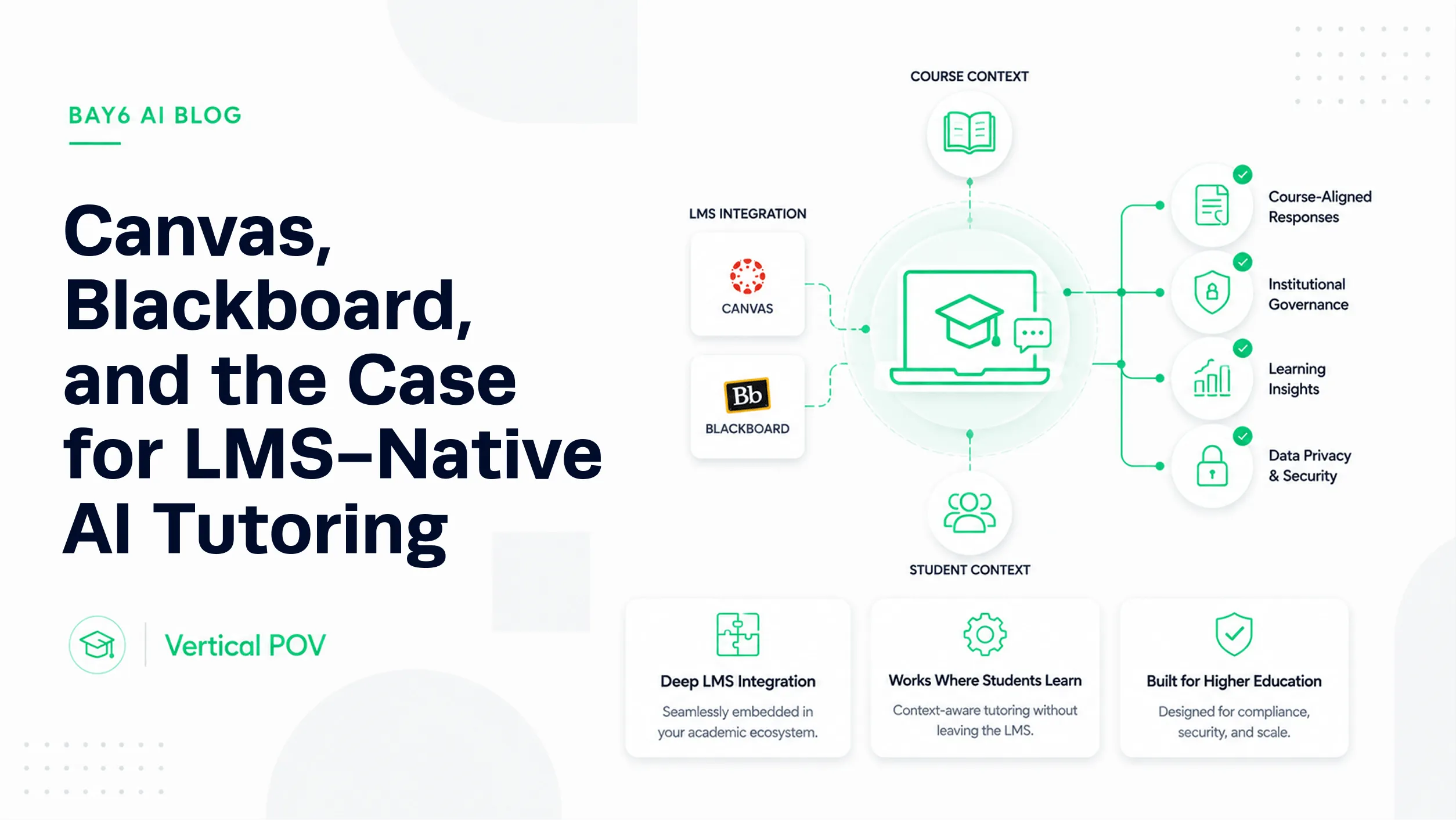
The LMS is the operational center of digital teaching and learning in US higher education. Students check assignments, readings, announcements, grades, discussions, quizzes, and course resources there. Faculty organize instruction there. Instructional technology teams manage integrations, access, support, and compliance there. Academic affairs depends on it as the system where digital learning actually runs. Any serious AI tutoring strategy has to respect that reality.
This is why LMS-native AI tutoring matters. If a tutor sits outside the LMS, it may still answer questions. The problem is context. A separate tool asks students to leave the workflow, re-explain the course, paste materials, describe the assignment, and hope the response aligns with what the instructor expects. That creates friction for students and risk for institutions. The moment of confusion gets moved away from the academic environment.
Embedded support reduces adoption friction
Inside the LMS, the tutor can operate closer to the course. It can use course materials, understand enrollment boundaries, fit existing identity structures, and appear where students already work. That placement matters because adoption is rarely won through another portal. Faculty and students already manage too many systems. A support tool that adds another login, another workflow, and another place to check creates unnecessary resistance.
How LMS-native tutoring supports each buyer
For CIOs and LMS administrators, the LMS-native argument is also about control. The LMS already carries permissions, course sections, user roles, and integration standards. A tutor connected to that environment can respect who has access to which course. It can support faculty, students, admins, and academic teams through different permission levels. It can fit into institutional technology governance instead of becoming a shadow support tool.
For faculty, the LMS matters because course context matters. A response should reflect the course materials, the learning objectives, and the expectations of the instructor. A finance course, first-year writing seminar, nursing course, and biology lab should not receive the same generic AI support. LMS-native tutoring gives the institution a better path to course-aware responses and faculty-managed knowledge.
Student-success teams need signal, not silence
For student-success teams, the LMS matters because visibility matters. When tutoring interactions happen inside the course environment, usage patterns can become meaningful support signals. Leaders can see whether students use help before exams, whether usage happens after hours, whether specific concepts trigger repeated questions, and whether unanswered questions point to course friction. A disconnected tool may help privately. An LMS-native tutor can also inform the institution.
How StudyBuddy fits into Canvas and Blackboard workflows
StudyBuddy is built around this operating model. It integrates with Canvas and Blackboard through validated deployments. It is grounded in course materials and supports course-aware Q&A, Socratic tutoring, quizzes, study plans, controlled source use, citations, transcripts, feedback, usage reporting, and institutional review. Its architecture can extend to Moodle, D2L Brightspace, and other learning environments, but the validated Canvas and Blackboard proof points should be central in evaluation conversations.
The key phrase for buyers is practical deployment. AI tutoring does not need to begin as a sprawling campus transformation. It can begin in the LMS, inside selected courses, with a clear support goal and a measured pilot. Start with high-enrollment courses, online programs, first-year courses, gateway subjects, or programs where after-hours support demand is high. Connect the tutor to the materials students already use. Monitor adoption and quality. Expand based on evidence.
Governance strengthens the integrity conversation
LMS-native tutoring also strengthens academic integrity conversations. A generic AI tool can provide answers without any course oversight. StudyBuddy can support guided learning inside the course context, with faculty-visible transcripts, citations, unanswered-question monitoring, and feedback. That does not eliminate every academic integrity concern. It gives the institution a more defensible support channel than unmanaged student AI use.
What implementation teams need to verify
The implementation case should be explained in operational terms. First, secure access should follow institutional identity and enrollment logic. Second, course-material ingestion should be clear and governed. Third, role-based permissions should define what students, faculty, administrators, and support teams can see and do. Fourth, quality review should rely on patterns, feedback, and transcripts rather than forcing faculty to manually police every interaction. Fifth, reporting should connect tutor usage to support outcomes.
A strong LMS-native AI tutor should answer the questions CIOs ask during procurement. How is access controlled? How are materials ingested? How are courses separated? What data is retained? Can the institution review logs? Can faculty update knowledge sources? How are citations handled? What analytics are available? Can the tool support accessibility needs? Can it scale beyond a small pilot? StudyBuddy’s product story is strongest when these details are made visible.
Adoption depends on operational fit
The adoption case is equally important. Students are more likely to use help that appears where they are already working. Faculty are more likely to trust a tutor that reflects their course materials. Academic teams are more likely to support a tool that produces reviewable signals. IT teams are more likely to approve a system that fits established technology governance. LMS-native deployment improves the operating conditions for all four groups.
This is the reason the phrase “inside Canvas and Blackboard” should carry weight in StudyBuddy messaging. It is not a minor integration claim. It tells buyers that StudyBuddy is designed for institutional workflows. It also separates StudyBuddy from tools that require students to leave the LMS and recreate context manually. Enterprise buyers trust specificity. A named, validated integration is more credible than broad promises about compatibility.
Why named LMS integrations matter
The future of AI tutoring in higher education will not be defined by who can generate the most fluent answer. It will be defined by which tools can fit responsibly into academic operations. The LMS is where that responsibility starts. It holds the context, permissions, materials, and routines that make tutoring relevant to real courses.
What proof should decide scale
StudyBuddy gives colleges and universities a direct way to make AI tutoring operational. It places help in the learning environment, aligns support to course materials, and gives academic teams visibility into how students use the tutor. That is the case for LMS-native AI tutoring: better access, better context, better governance, and better measurement.
For implementation teams, the deployment plan should stay concrete. Choose the LMS environment, confirm the integration path, identify the initial course set, define which materials will ground the tutor, and specify the roles that need visibility. The first launch does not need to cover every department. It needs to prove that students will use course-aware help when it appears inside the workflow and that academic teams can review the resulting support signals.
Behavior should decide expansion
The most persuasive evidence will come from behavior. Did students use the tutor without heavy promotion? Did they return before deadlines or exams? Did after-hours usage appear? Did faculty see fewer repeated questions? Did transcripts show that students were seeking concept clarification rather than only final answers? Did unanswered-question patterns lead to course improvements? These are the indicators that show LMS placement is doing real operational work.
StudyBuddy’s Canvas and Blackboard integrations should therefore be treated as buying evidence, not technical trivia. They show that the product can sit where students already study, where faculty already manage instruction, and where IT already governs access. That reduces adoption friction and makes the tutor easier to defend in academic and procurement review. The strongest message is simple: AI tutoring should not require students to leave the learning environment to receive course-aware help.
FAQs
- What does LMS-native AI tutoring mean?
It means AI tutoring is available inside the learning management system, connected to course context, enrollment boundaries, permissions, and academic workflows. - Why are Canvas and Blackboard integrations important?
They show that AI tutoring can operate inside systems institutions already manage, reducing context switching while supporting governance and adoption. - Does LMS integration improve student use?
It can improve use because students access help where they already work, instead of moving into a separate tool at the moment of confusion. - How does StudyBuddy support LMS-native tutoring?
StudyBuddy has live and validated integrations with Canvas and Blackboard and is designed to provide course-grounded support inside institutional learning workflows.
Assess StudyBuddy fit for your Canvas or Blackboard environment.
Book a Demo