

Ask ten enterprises whether they have AI governance and most will say yes. Ask whether that governance controls daily AI work inside customer service, claims, underwriting, financial operations, student services, legal review, or knowledge workflows, and the answer gets weaker.
The problem is not intent. The problem is distance. Governance often sits in policy documents, committees, procurement reviews, and training decks. The work happens in systems, queues, cases, tickets, chats, documents, models, and approvals.
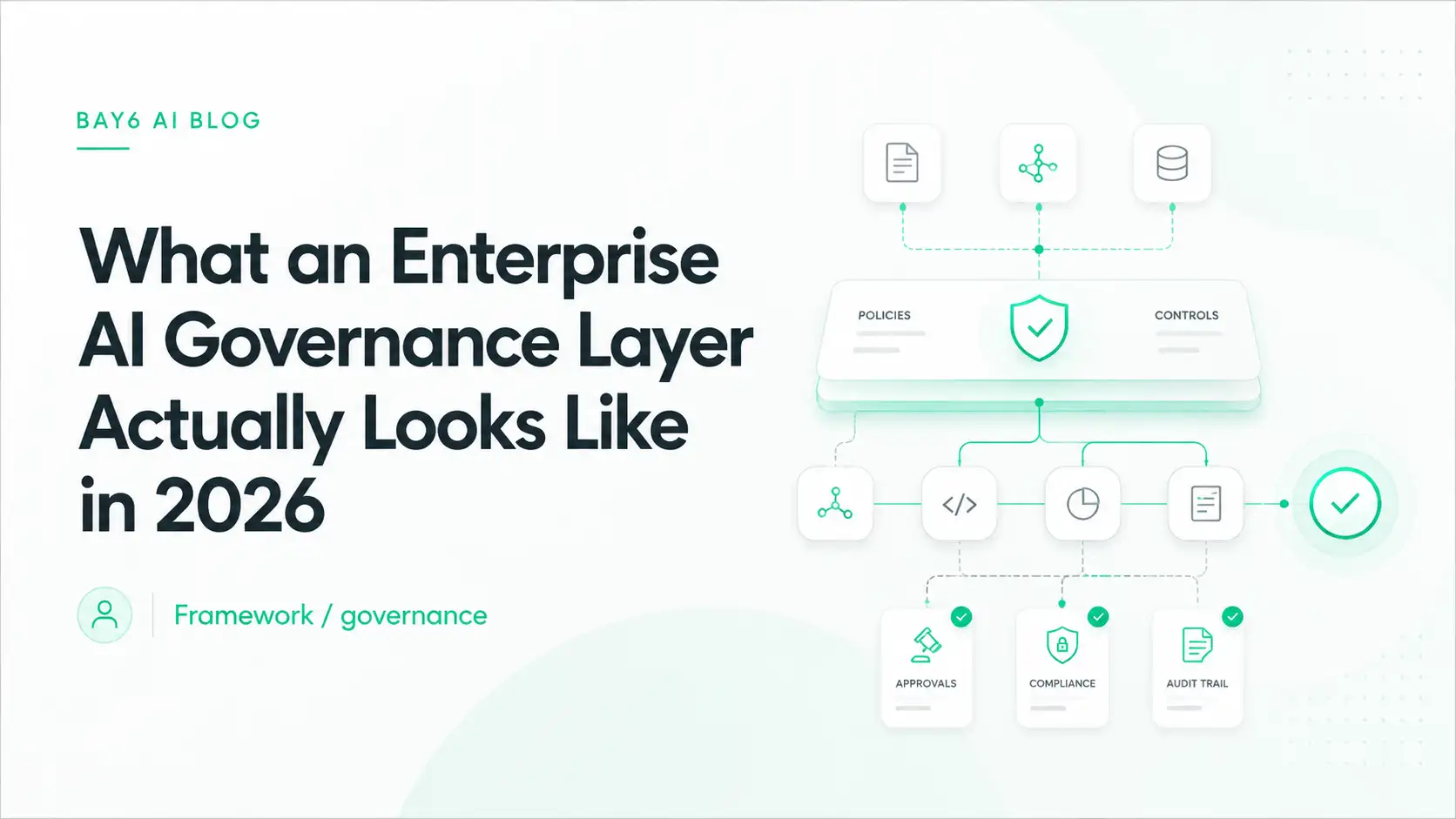
An enterprise AI governance layer closes that gap. It makes controls operational. It defines what AI can know, what it can do, when it must escalate, what evidence it must leave, and how performance will be reviewed.
The five components of a real governance layer
First, identity. Every AI agent, assistant, model, and automation pathway needs a defined role. Treating AI like a generic tool creates accountability gaps. Treating AI like a controlled actor creates governance clarity.
Second, permissioning. AI should not inherit broad access because the implementation was rushed. Access needs to match the workflow, the user role, the data class, and the action being performed.
Third, policy logic. Policy cannot live only in PDFs. It needs to be translated into routing rules, allowed actions, confidence thresholds, approval steps, escalation paths, and exception handling.
Fourth, auditability. The enterprise needs logs that explain inputs, outputs, actions, overrides, reviewers, timestamps, and downstream outcomes. If the organization cannot reconstruct the workflow, it cannot defend it.
Fifth, outcome measurement. Governance is not only about reducing risk. It is also about proving that AI is producing better business results without creating operational debt.
What the layer does in practice
In a claims workflow, the governance layer determines which policy data can be used, which claims can be routed automatically, when a human adjuster must review, and what evidence is retained.
In financial services, it can define boundaries around model-assisted risk review, customer communication, fraud triage, and exception approval. The point is not to slow the business. The point is to prevent speed from creating exposure.
In education, it can separate academic guidance from operational support, manage escalation to staff, and prevent AI from giving unsupported or policy-inconsistent responses to students.
In legal, it can keep AI inside matter-specific context, preserve confidentiality controls, and create review trails for research, document analysis, intake, or workflow support.
Governance should make execution safer and faster
Bad governance slows teams down because it is disconnected from the work. Good governance speeds teams up because it gives them safe lanes to operate inside.
This is a critical distinction. Enterprise leaders do not need more abstract AI principles. They need a practical control system that lets business teams deploy AI in repeatable, measurable, auditable ways.
The governance layer should answer simple questions quickly: Can this workflow use AI? What can AI access? What can it do? When does a human review? What gets logged? Which metric tells us whether this is working?
The Bay6 AI position
Bay6 AI believes enterprise AI governance needs to be designed with workflow execution from day one. Governance that arrives after deployment becomes remediation. Governance built into deployment becomes operating advantage.
Forge6 is the natural home for this conversation: roadmap, governance, Center of Excellence design, solution architecture, and measurable impact. The goal is not AI theater. The goal is controlled AI performance inside real enterprise systems.
In 2026, the winners will not be the companies with the longest AI policy. They will be the companies with the clearest control layer between AI intelligence and business action.
FAQs
- What are the components of an enterprise AI governance layer?
An enterprise AI governance layer includes identity, permissioning, policy logic, auditability, and outcome measurement. Together, these controls define what AI can access, what it can do, when humans review, what gets logged, and how success is measured.
- What should enterprise buyers measure before deploying AI in this workflow?
Enterprise buyers should measure current workflow performance, data sensitivity, risk exposure, review requirements, and expected business impact. Key metrics may include cycle time, cost per task, error rate, escalation rate, compliance exceptions, and approval delays.
- How can AI reduce operational friction without removing human accountability?
AI can handle repetitive, document-heavy, or routing-based work while humans remain responsible for judgment, exceptions, approvals, and final decisions. The key is to build clear escalation paths, approval checkpoints, access controls, and audit trails into the workflow.
Talk to us. Let’s build what moves the needle.
Book a Demo