




Law firms are being pitched AI from every direction. Research assistants. Drafting tools. Contract review. Intake tools. Timekeeping tools. Knowledge search. Matter analytics. Client service automation. The volume alone creates fatigue.
The serious question for law firms is not which AI tool looks impressive in a demo. It is which AI workflow improves legal work without creating confidentiality, ethics, quality, billing, or client-trust problems.
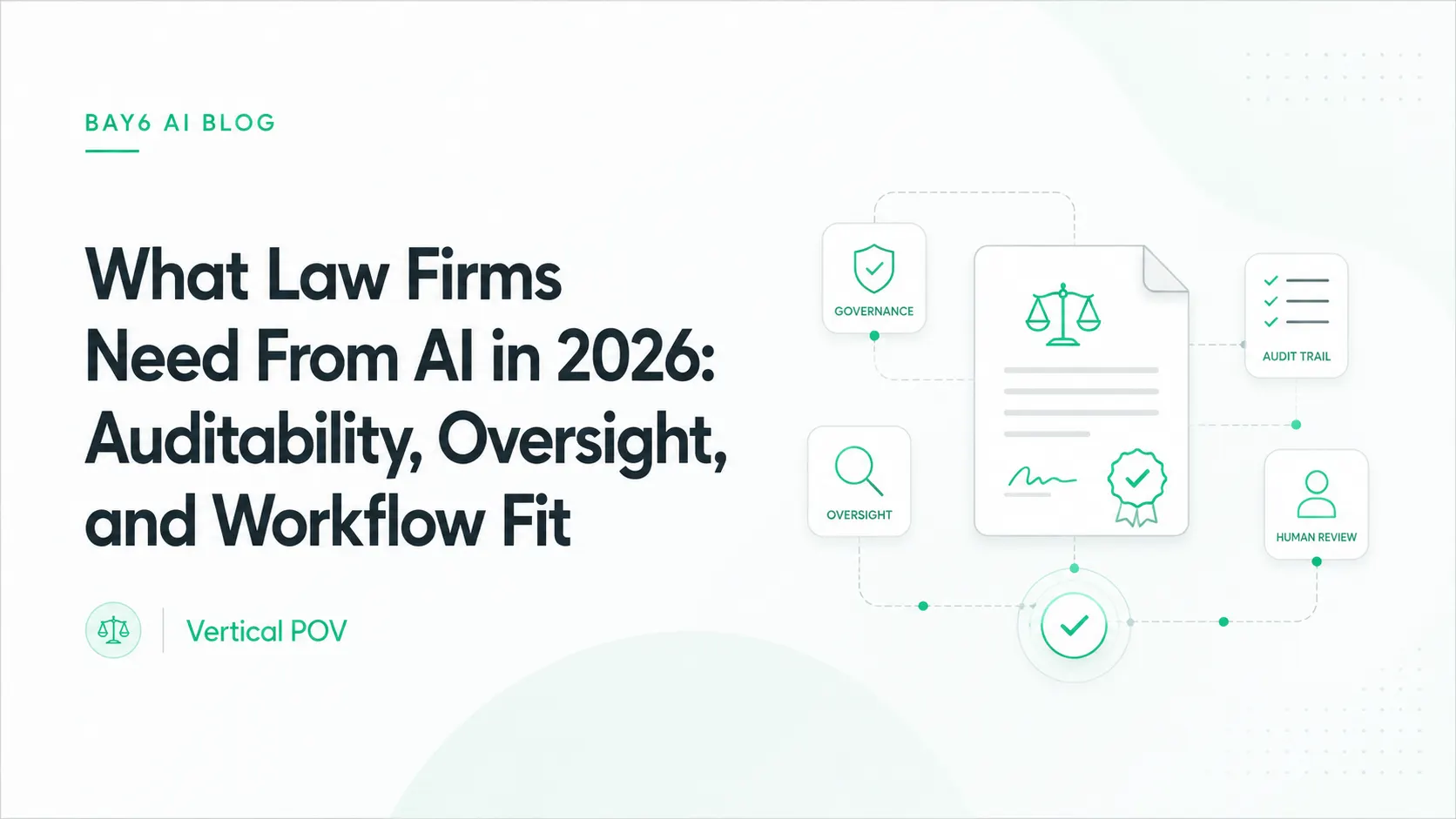
That means law firms need three things from AI in 2026: auditability, oversight, and workflow fit. Without those, adoption becomes risk wrapped in productivity language.
Auditability is non-negotiable
Legal work depends on trust. If AI supports research, document review, matter intake, client communication, knowledge search, or workflow routing, the firm needs to understand what the system used, what it produced, who reviewed it, and what changed before final use.
This is not bureaucracy. It is professional discipline. Partners cannot defend AI-supported work if the process is invisible. Clients will also ask harder questions about data handling, model use, confidentiality, and matter boundaries.
The audit trail does not need to make lawyers slower. Designed well, it reduces uncertainty and makes adoption easier because the control model is clear.
Oversight has to match risk
Not every AI use case needs the same level of review. A tool that summarizes internal administrative guidance has a different risk profile from a tool that supports legal research, contract analysis, client advice, or matter-specific document handling.
Law firms should classify AI workflows by confidentiality, legal impact, client visibility, data sensitivity, and dependency on professional judgment. The review model should follow that classification.
Human oversight should be designed into the process. A lawyer should not be expected to inspect every output manually in the same way. Some outputs require full review. Some require sampling. Some require exception review. The workflow should make that explicit.
Workflow fit matters more than feature count
Lawyers already have too much software. If AI requires constant context switching, duplicate data entry, or unclear matter boundaries, adoption will stall. The tool may be technically useful and operationally ignored.
Workflow fit means AI works with matter context, permissions, document stores, practice-group knowledge, intake flows, billing practices, and review habits. It should reduce friction, not create another system for lawyers to babysit.
This is where many pilots fail. They prove a feature, not a workflow. Firms need success metrics before pilots begin: time saved, quality improvement, faster intake, lower research burden, better document retrieval, improved client responsiveness, or reduced administrative drag.
Where law firms should start
Start with internal knowledge retrieval and administrative workflows where risk is lower and value is visible. Practice-group knowledge, policy lookup, matter opening support, experience search, and internal service requests can create quick wins.
Next, move into higher-value workflows with stronger controls. Document analysis, research support, client intake, and matter triage need matter-specific boundaries, review logic, and audit records.
Avoid the temptation to treat AI as a universal assistant. Law firms do not need general-purpose magic. They need bounded tools that respect the work.
The Bay6 AI position
Bay6 AI brings a practical enterprise lens to law firm AI. The real opportunity is not replacing lawyers. It is reducing avoidable operational drag while preserving review, confidentiality, and client confidence.
Connect6 can support governed self-service and knowledge access. Agent6 can support controlled action. Forge6 can help firms design governance, adoption roadmaps, and use-case prioritization. The key is fit: AI should serve the workflow, not force the workflow to serve the tool.
Law firms that adopt AI carefully will move faster than firms that wait. Firms that adopt AI casually will create the exact problems cautious firms are worried about.
FAQs
- What should law firms require from AI tools in 2026?
Law firms should require AI tools to provide auditability, human oversight, confidentiality controls, and workflow fit. AI should show what information it used, what it produced, who reviewed it, and how outputs changed before final use. The tool should also respect matter boundaries, permissions, review requirements, and client-trust obligations. - What should enterprise buyers measure before deploying AI in this workflow?
Enterprise buyers should measure the workflow baseline before deploying AI. Key metrics include time spent, review effort, research burden, document retrieval speed, intake cycle time, administrative workload, quality issues, client responsiveness, and adoption friction. These metrics help determine whether AI improves the workflow instead of adding another system for lawyers to manage. - How can AI reduce operational friction without removing human accountability?
AI can reduce operational friction by supporting knowledge retrieval, matter intake, document review, routing, summaries, and administrative workflows. Human accountability remains in place when lawyers review high-impact outputs, approve client-facing work, handle exceptions, and oversee workflows involving legal judgment, confidentiality, or matter-specific risk.
Explore how Bay6 AI can help law firms.
Book a Demo