

AI adoption without profit discipline is expensive theater
Financial institutions do not need another AI pilot that proves a model can answer a question. They need AI that improves economics without compromising control.
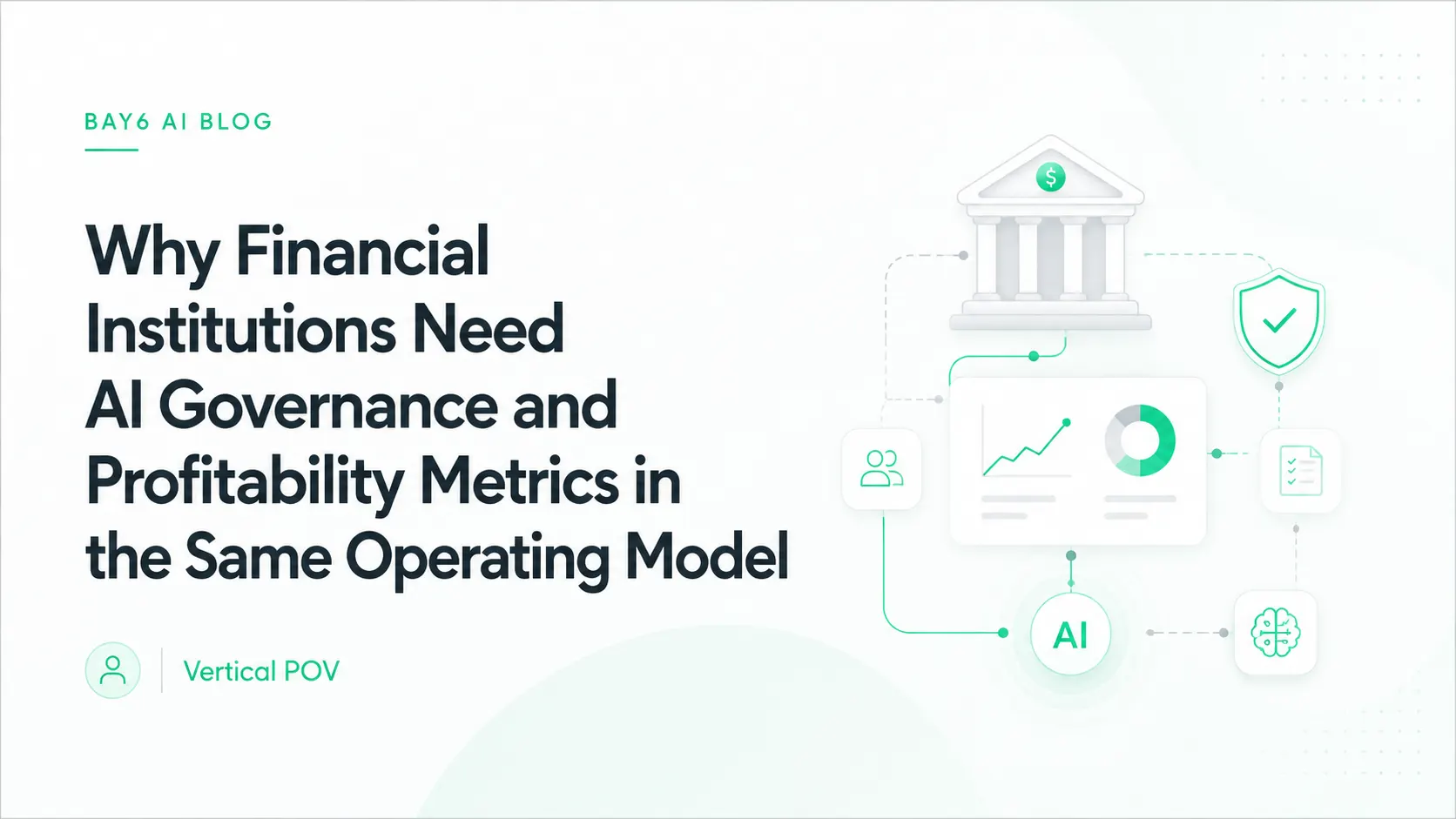
That means governance and profitability cannot sit in separate conversations. Risk teams cannot govern AI in a vacuum. Business teams cannot chase productivity without evidence. Technology teams cannot deploy models without operating metrics. The value case and control case need to be designed together.
This is especially true in banking, lending, wealth, insurance-adjacent financial services, and customer operations. AI can reduce cost, improve decision speed, personalize service, detect risk, and reduce friction. It can also create compliance exposure, inconsistent treatment, data leakage, and explainability problems if deployed casually.
The mistake: treating risk and ROI as opposing forces
Many organizations still frame AI governance as the brake and AI growth as the accelerator. That framing is wrong. Strong governance is what allows AI to scale into higher-value workflows.
A financial institution can experiment with a generic assistant without much operating discipline. It cannot apply AI to complaints, fraud triage, credit exceptions, servicing recommendations, churn prediction, or customer communications without clear ownership and evidence.
The more material the workflow, the more valuable governance becomes. It gives business leaders permission to move beyond demos and into controlled production.
What the shared operating model should contain
First, a use-case scorecard. Every AI initiative should be scored by business value, workflow complexity, data readiness, customer impact, regulatory sensitivity, implementation effort, and measurement clarity.
Second, a control gate. Before production, the team should define who can use the AI, what data it can access, which decisions it can influence, when a human reviews, what gets logged, and how exceptions are handled.
Third, a profitability baseline. Financial institutions need numbers before deployment: current cost per interaction, cycle time, rework rate, error rate, abandonment, complaints, retention, fraud losses, or revenue leakage. Without a baseline, ROI becomes a story instead of a metric.
Fourth, post-launch monitoring. AI should be reviewed against quality, risk, customer experience, operational performance, and financial impact. A model can look effective in aggregate while creating problems in specific segments or workflows.
Where this matters first
Customer servicing is a strong entry point because volume is high and the pain is visible. AI can answer approved questions, route cases, prepare agent summaries, and reduce repeat contacts.
Fraud and risk operations are also strong candidates, provided AI is used to prioritize and support review instead of making unexplained decisions that teams cannot defend.
Churn and retention workflows can benefit from predictive modeling. Model6-style intelligence can identify patterns that show which customers are at risk and what intervention might matter.
Complaints and disputes deserve special attention. These workflows carry customer, regulatory, and reputational stakes. AI can speed evidence gathering and routing, but final ownership must remain explicit.
The Bay6 AI position
Bay6 AI fits financial institutions because it does not treat AI as a standalone feature. It treats AI as a workflow capability that needs context, controls, prediction, integration, and measurable business outcomes.
Connect6 can reduce service friction. Model6 can support predictive decisioning. Forge6 can help define governance, roadmap, ROI, and the operating model needed for scale. Agent6 can support action inside defined boundaries.
The financial institutions that win with AI will be the ones that stop separating governance from economics. Control is not the opposite of performance. Done right, it is the path to performance.
FAQs
- How should financial institutions measure AI ROI and governance together?
Financial institutions should measure AI ROI and governance in one operating model. Each AI use case should be evaluated by business value, risk level, data readiness, workflow impact, human review needs, and measurable outcomes such as cost reduction, cycle time, error rate, complaints, retention, or revenue leakage. - What should enterprise buyers measure before deploying AI in this workflow?
Enterprise buyers should measure the workflow’s current baseline before deploying AI. Key metrics include cost per interaction, case volume, cycle time, rework rate, error rate, escalation rate, customer complaints, fraud losses, retention, and revenue leakage. This baseline makes AI impact easier to prove after launch. - How can AI reduce operational friction without removing human accountability?
AI can reduce operational friction by routing work, preparing summaries, answering approved questions, detecting patterns, and supporting faster decisions. Human teams should still own material decisions, exceptions, customer-impacting actions, and regulated workflows.
Discuss how Bay6 AI can connect AI governance.
Book a Demo