

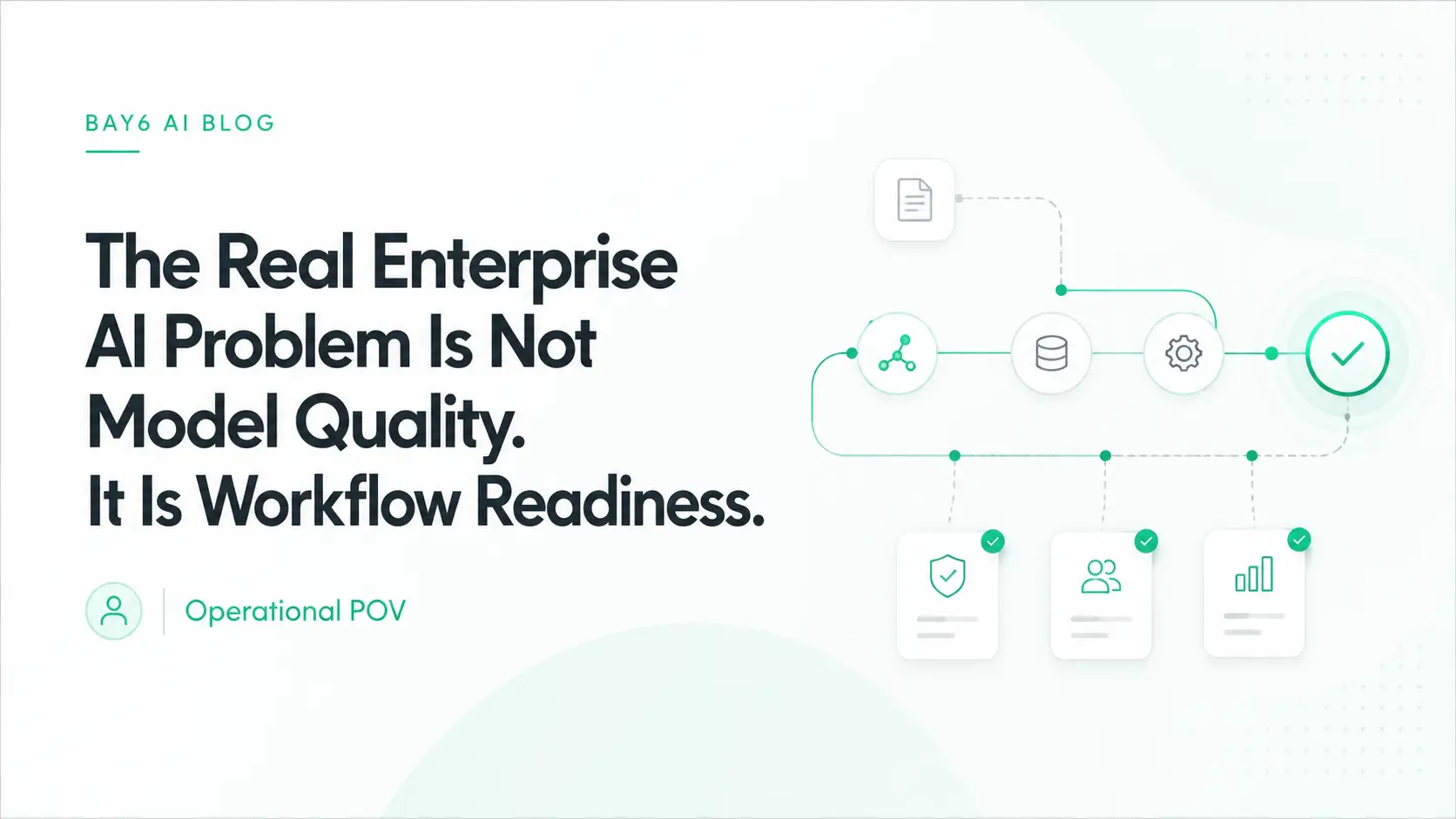
Enterprise teams still argue about model quality as if that is the main blocker. It is not. The model is rarely the weakest link anymore. The weakest link is the messy space between an AI answer and a business action.
A model can summarize a policy, classify an inquiry, score a risk, or recommend a next step. That does not mean the enterprise is ready to use that output inside a real workflow. The workflow still needs data access, permission checks, handoffs, approvals, exception paths, audit history, and measurable ownership.
That is why AI pilots look impressive in conference rooms and then stall in production. The demo shows intelligence. The business needs controlled execution.
Where AI pilots break
They break when the knowledge base is stale. They break when permissions are unclear. They break when the AI needs data from three systems and each system has a different owner. They break when exceptions require human judgment but no one has mapped the escalation path.
They also break when success is defined too vaguely. A team says the AI improved productivity. Good. By how much? In which workflow? Against what baseline? Did it reduce cost, cycle time, error rate, handle time, abandonment, leakage, churn, or manual rework?
This is the part executives need to confront. AI value does not appear because a model is smart. AI value appears when the enterprise redesigns work around the model without losing control.
Workflow readiness has specific requirements
A workflow-ready AI program starts with the process map. Not a theoretical journey map. A real operating map that shows inputs, systems, decision points, handoffs, exceptions, owners, controls, and outcomes.
The second requirement is governed access. AI should see what it is allowed to see, act only where it is allowed to act, and escalate when confidence, policy, or role boundaries require human review. This cannot depend on employee discipline alone.
The third requirement is measurement. Every AI workflow should have a small set of operating metrics: time saved, volume handled, containment rate, resolution quality, error reduction, escalation rate, compliance exceptions, and financial impact.
The fourth requirement is feedback. AI cannot be treated as a one-time implementation. It needs continuous review of failures, overrides, ambiguous cases, customer friction, and business outcomes.
What better operators do differently
Better operators do not start with the biggest model. They start with the highest-friction workflow. They ask where volume is high, patterns repeat, decision latency is expensive, and existing teams are overloaded.
Then they define the role of AI precisely. Is it answering? Routing? Predicting? Recommending? Acting? Escalating? The more precise the role, the easier it becomes to design controls and measure value.
They also keep humans in the right place. Human oversight is not a checkbox. It is a design decision. Some workflows need review before action. Some need review after action. Some need exception-only review. Getting this wrong either kills efficiency or creates risk.
The Bay6 AI position
Bay6 AI is built around the reality that enterprises do not need more isolated AI experiments. They need AI that understands context, fits existing systems, acts with intent, and produces measurable outcomes.
That means readiness is not a soft consulting term. It is the hard infrastructure of enterprise AI performance. Data, permissions, workflow logic, handoff design, governance, measurement, and change management all sit in the same operating system.
The companies that win with AI in 2026 will not be the companies with the most pilots. They will be the companies with the fewest disconnected pilots and the strongest workflow discipline.
FAQs
- Why do enterprise AI pilots fail even when the model works?
Enterprise AI pilots fail when the workflow is not ready for production. A model may produce useful answers, but the business still needs data access, permissions, handoffs, approvals, exception paths, audit history, ownership, and measurable outcomes for AI to create real value. - What should enterprise buyers measure before deploying AI in this workflow?
Enterprise buyers should measure the workflow baseline before deploying AI. Key metrics include time saved, volume handled, containment rate, resolution quality, error rate, escalation rate, compliance exceptions, manual rework, cycle time, cost impact, and financial value. - How can AI reduce operational friction without removing human accountability?
AI can reduce operational friction by answering, routing, predicting, recommending, escalating, and preparing work for human review. Human accountability stays in place when AI access is governed, actions are permission-based, exceptions are escalated, and sensitive workflows include the right level of review.
Schedule a workflow readiness assessment with Bay6 AI.
Book a Demo