

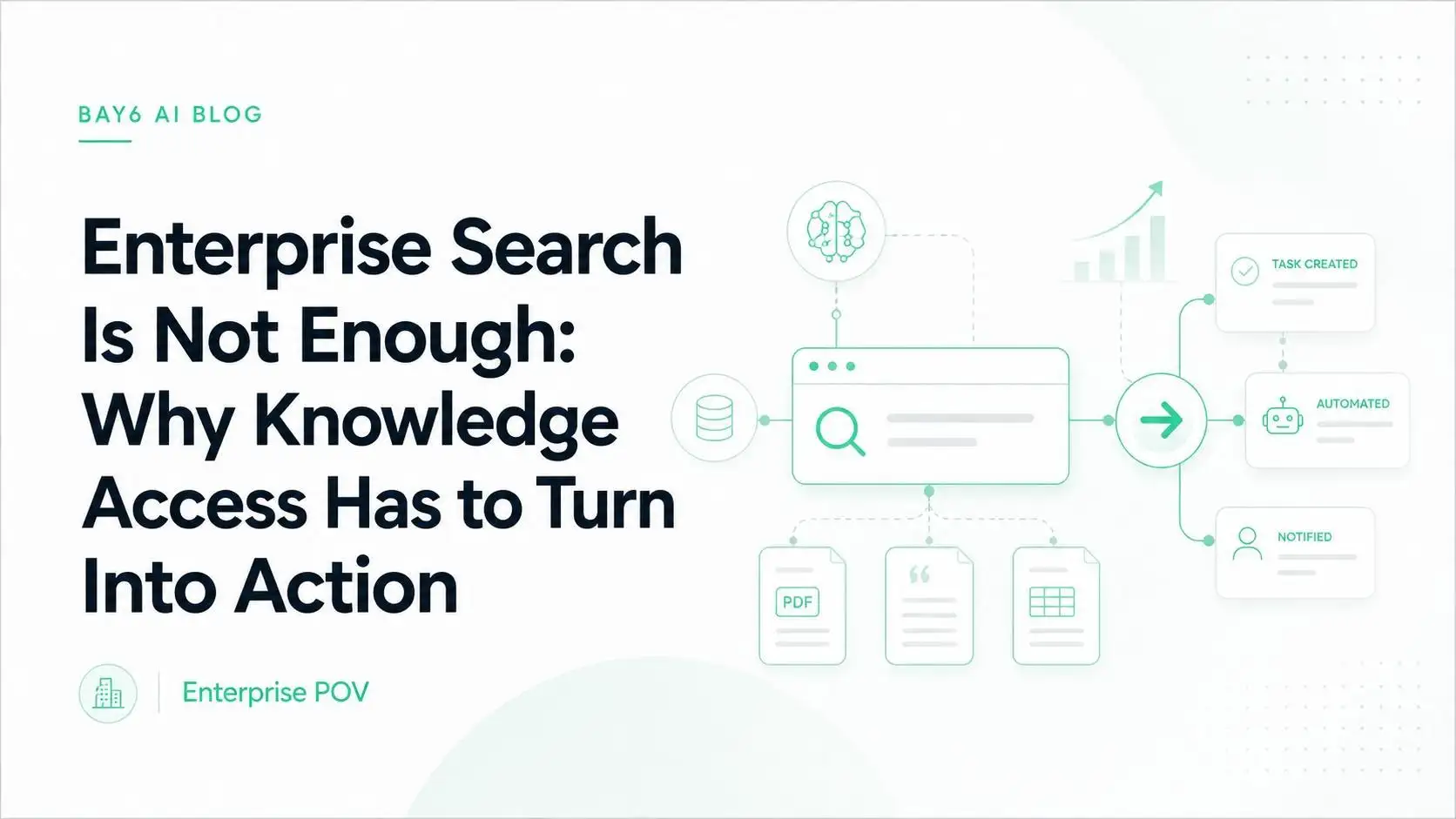
Enterprise search has improved. Employees can find documents faster. Customers can ask questions in natural language. Agents can retrieve policy snippets. That is progress, but it is not enough.
The problem is that most enterprise work does not end with an answer. It ends when a case is updated, a claim is routed, a student receives support, a customer issue is resolved, an exception is reviewed, a form is submitted, or a next-best action is taken.
Search gives access. Enterprise AI needs to create action.
Why search-only AI disappoints
Search-only AI often creates a polished dead end. It tells the user what the policy says but cannot apply it. It finds the procedure but cannot start it. It summarizes the document but cannot route the case. It gives an answer but leaves the employee to complete the work manually.
That might be acceptable for simple information retrieval. It is not enough for enterprise workflows with volume, urgency, and accountability.
Buyers are starting to notice. The question is shifting from can AI answer to can AI help the organization finish the job.
Knowledge needs context, permission, and action
The first requirement is context. AI needs to understand who is asking, what workflow they are in, what case or customer or student or policy is relevant, and what outcome the user is trying to reach.
The second requirement is permission. AI should not expose knowledge or perform actions simply because it can retrieve information. Access and action rights need to match role, workflow, data class, and policy boundaries.
The third requirement is action. Once the answer is known, AI should be able to trigger a governed next step: route, collect information, update a system, escalate, generate a summary, create a ticket, or prepare a reviewer packet.
The fourth requirement is measurement. If AI only counts answers delivered, leaders miss the real question: did work move forward?
What action-oriented knowledge AI looks like
In insurance, it answers policy questions, identifies missing claim information, routes the case, and hands complex issues to an adjuster with full context.
In financial services, it explains a servicing step, gathers missing details, classifies the request, and routes exceptions to the right review queue.
In education, it answers approved student questions, helps with forms or deadlines, and escalates sensitive issues to staff instead of trapping students in automation.
In legal and enterprise knowledge workflows, it retrieves matter-specific or policy-specific information while respecting permissions and review requirements.
The Bay6 AI position
Bay6 AI is built around the idea that knowledge should not sit idle. Connect6 turns approved knowledge into intelligent first-line response. Agent6 can support bounded action. Model6 can add predictive intelligence. Forge6 can define the governance and roadmap required for production.
The next phase of enterprise AI will not be won by the best search box. It will be won by systems that connect knowledge to workflow progress without losing control.
That is the shift enterprise buyers should demand now: fewer answers that stop at advice, more AI that helps work get done.
FAQs
- Why is enterprise search not enough for knowledge AI?
Enterprise search helps users find answers, but most enterprise work does not end with an answer. Knowledge AI needs to connect information to action, such as routing a case, updating a system, escalating an issue, creating a ticket, collecting missing details, or preparing a reviewer summary. - What should enterprise buyers measure before deploying AI in this workflow?
Enterprise buyers should measure whether knowledge access actually moves work forward. Key metrics include search success, answer accuracy, time to resolution, handoff rate, escalation rate, case routing speed, ticket volume, employee effort, repeated questions, and workflow completion rate. - How can AI reduce operational friction without removing human accountability?
AI can reduce friction by retrieving approved knowledge, summarizing context, routing requests, collecting missing information, and preparing next steps. Human accountability stays in place when AI actions are permission-based, logged, reviewed for sensitive workflows, and escalated when judgment or approval is required.
See how Bay6 AI turns enterprise knowledge into governed workflow action.
Book a Demo