property_casuality_box
property_casual_dark_logo
2026 PropertyCasualty360 Insurance Luminaries Finalist – Product or Service Innovation

Use Cases

 / 

Education

Student Retention Risk Intelligence and Intervention Management

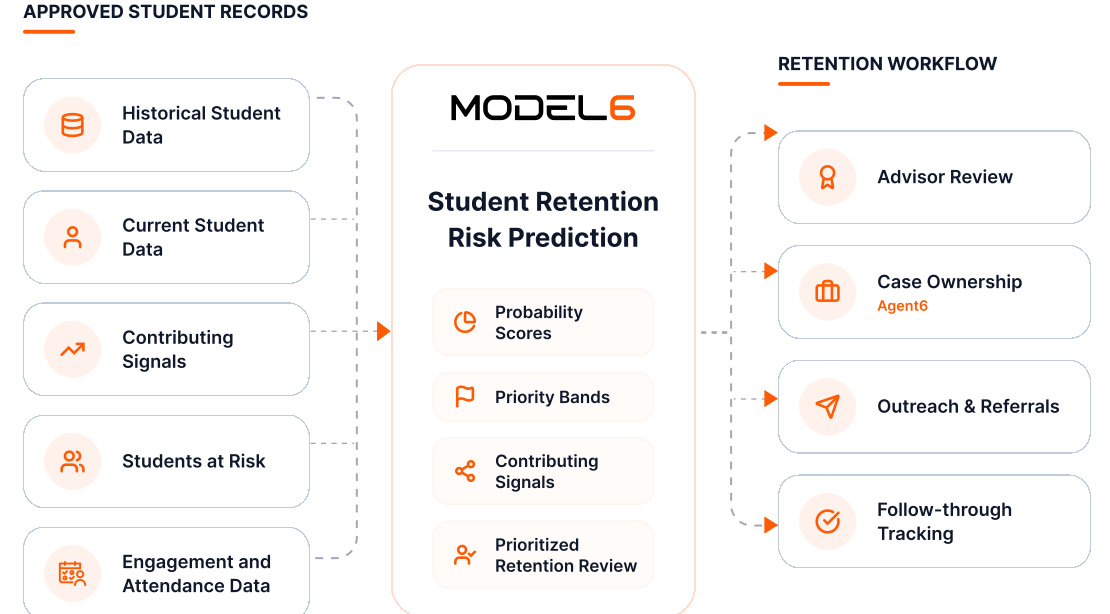
Institutions can use Model6 to analyze approved historical and current student data and identify students who may be at risk of disengagement, stop-out, or withdrawal. Probability scores, priority bands, and contributing signals support earlier review across retention, advising, and student success teams. 


Agent6 can convert the approved signal into accountable workflow activity by creating cases, balancing queues, assigning ownership, preparing context, coordinating outreach and referrals, and tracking follow-through. Connect6 can support approved student communication and appointment coordination when the institution includes a conversational channel. 

student-retention-risk-intervention-management-capability

Why This Use Case Matters

01
Student disengagement usually develops through several weak signals rather than one clear event. LMS activity declines, assignments become inconsistent, registration or payment issues appear, appointments are missed, support requests increase, and communication slows.
02
By the time a withdrawal or stop-out is visible in formal reporting, the most useful intervention window may have narrowed. Institutions need earlier risk intelligence and a disciplined operating model for deciding who reviews the signal, what action is permitted, and how completion and outcomes are measured.

Why This Use Case Matters 

Every early student-risk signal creates an opportunity for timely support. Explore how Bay6 AI helps institutions identify possible disengagement earlier, prioritize advisor attention, and coordinate measurable, human-led interventions.

Many institutions can identify student risk retrospectively but still lack a consistent path from predictive signal to prioritized advisor review, coordinated support, and documented closure.

  • Risk indicators are spread across SIS, LMS, CRM, advising, attendance, financial, support, and communication systems.
  • Student success teams often rely on lagging reports or manual monitoring.
  • Broad alert lists create noise without explaining priority, contributing factors, ownership, or next action.
  • Different units may contact the same student without a shared view of intervention status.
  • Leaders cannot easily connect prediction, human review, outreach, support action, closure, and student outcome.
  • Model performance may change as programs, modalities, student populations, and institutional practices evolve.
  • Institutions need predictive insight without automating academic, financial, registration, or student eligibility decisions.

Model6 creates an institution-specific predictive layer around a defined student population, observation point, and retention outcome. It can combine approved data, estimate risk, organize contributing signals, and support relative prioritization for authorized teams.

Agent6 connects the prediction to a defined intervention workflow. It can create or update a case, assign the appropriate advisor or support unit, prepare a concise context summary, initiate approved outreach, appointment, referral, or escalation tasks, and record status and outcomes where integrations permit. Connect6 can support approved student communication when the institution includes a conversational channel.

Operating principle: A retention model is useful only when the institution can interpret the signal, prioritize limited advising capacity, assign accountable ownership, complete an approved support action, and measure the outcome. Predictive intelligence remains decision support and must not determine academic standing, aid, registration access, discipline, or student eligibility.

How the Retention and Intervention Workflow Works

See how Bay6 AI combines predictive intelligence, workflow automation, and coordinated human action to support every stage of the student retention and intervention journey.

01

Define the retention outcome and intervention boundary

The institution identifies the student population, observation point, prediction window, target outcome, exclusions, advisor roles, permitted actions, and decisions that remain outside the workflow.
02

Review data readiness

Approved SIS, LMS, CRM, advising, attendance, financial, registration, support, and communication data are assessed for quality, timing, relevance, access, and bias.
03

Build and validate the institution-specific model

Model6 identifies historical patterns associated with persistence, disengagement, stop-out, withdrawal, or another defined outcome and validates performance across approved groups.
04

Score and prioritize the eligible population

Students receive probabilities, priority bands, or segments through approved batch or API-based delivery.
05

Surface contributing signals and context

Authorized reviewers can see approved factors such as engagement decline, missed milestones, registration gaps, unresolved holds, or prior outreach status.
06

Assign ownership and coordinate intervention

Agent6 can create or update a case, balance queues, assign the authorized owner, prepare context, and initiate configured outreach, appointment, referral, or escalation tasks.
07

Track closure, outcomes, and model health

Teams record review, outreach, response, appointment, referral, override, closure, and student outcome data while monitoring calibration, drift, segment performance, and governance

What Model6 and Agent6 Help Retention and Advising Teams Do

Explore how Model6 and Agent6 help teams identify possible student risk, prioritize advisor caseloads, coordinate interventions, assign ownership, and track support activity through completion.

student-retention-risk-intervention-management-capability
01
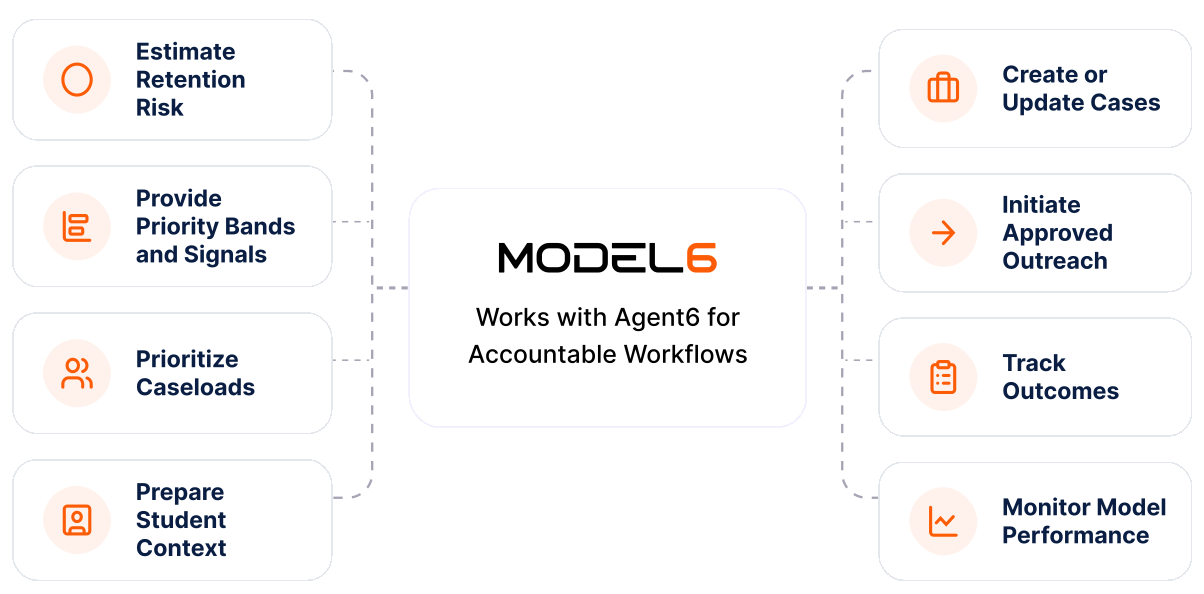
Estimate institution-defined disengagement, stop-out, withdrawal, or persistence risk using approved data.
02
Provide priority bands, segments, and contributing signals for authorized review.
03
Prioritize advisor and student-success caseloads by population, program, term, modality, cohort, support need, or configured rule.
04
Prepare concise student context from approved systems before advisor review.
05
Create or update cases, assign ownership, balance queues, and prevent duplicate or uncoordinated intervention activity where workflow status is available.
06
Initiate approved outreach, appointment, referral, and escalation tasks without removing human judgment.
07
Track advisor acceptance, overrides, intervention completion, student response, closure, and outcomes.
08
Monitor model calibration, lift, stability, drift, segment performance, operational usefulness, access, and audit traceability.

What Institutions Can Improve

Explore how institutions can improve risk visibility, advisor prioritization, intervention coordination, case ownership, and follow-through across student-support teams.

  • Earlier identification of possible disengagement, stop-out, or withdrawal risk.
  • Prioritization and balancing of retention and advising caseloads.
  • Clarity of contributing signals and review context.
  • Time from qualifying signal to advisor review.
  • Case ownership, routing, outreach, referral, and intervention completion.
  • Coordination across advising, enrollment, academic, financial, and support teams.
  • Student response, appointment, registration, resource use, and activity recovery.
  • Model calibration, stability, drift, segment performance, overrides, and traceability.

The strongest outcome is: A governed retention operating model that connects institution-specific predictive intelligence to prioritized advisor review, coordinated human support, documented closure, and measurable student outcomes.

Pilot Measurement Areas

Measure the impact of your pilot with meaningful metrics that demonstrate operational efficiency, user adoption, and business value.

Measurement Area What to Track
Data readiness Availability, completeness, consistency, timing, access, lineage, and historical outcome quality.
Model performance Calibration, rank ordering, precision, recall, false positives, false negatives, lift, stability, and segment performance.
Signal usefulness Advisor and reviewer assessment of whether surfaced students and contributing factors are meaningful and timely.
Caseload and ownership Queue distribution, time to assigned owner, acceptance, reassignment, duplicate activity, and override rationale.
Intervention workflow Cases reviewed, outreach completed, appointments, referrals, escalations, follow-up, closure, and workflow adoption.
Student engagement and outcomes Responses, appointment attendance, registration completion, activity recovery, support completion, persistence, stop-out, withdrawal, and return where measurable.
Governance Access, model versions, thresholds, data controls, incidents, complaints, drift, review records, and audit evidence.

From Late Risk Detection to Coordinated Intervention

From Late Risk Detection to Coordinated Intervention

  • Each signal is visible in a different system and reviewed separately.
  • The student appears in broad reports after the risk becomes more visible.
  • Advisors reconstruct context and decide ownership manually.
  • Leadership sees final retention outcomes but limited evidence of intervention completion.

Without Bay6 AI

  • Model6 evaluates the combined pattern within the institution-defined retention model.
  • The student is surfaced earlier in a prioritized advisor review queue with contributing signals.
  • Agent6 prepares the available context, assigns the approved owner, and initiates the configured next step.
  • The workflow links prediction, review, outreach, referral, closure, and outcome for measurement.

With Bay6 AI

FAQs

Have questions? Browse our FAQs to learn more about how Bay6 AI works and how it supports your organization’s goals.

What is student retention risk intelligence and intervention management?

It combines institution-specific predictive risk signals with prioritized advisor review, case ownership, approved outreach and referral workflows, and measurable follow-through.

How is this different from an alert or retention report?

A report summarizes known activity. Model6 identifies patterns associated with a future outcome, while Agent6 can connect the approved signal to advisor queues, cases, tasks, and closure tracking.

What data can support the model?

Approved data may include SIS, LMS, CRM, advising, attendance, registration, financial, support, communication, and historical outcome data, subject to institutional governance.

Does Model6 make decisions about students?

No. Model6 provides decision-support signals. Academic, advising, financial, registration, outreach, and student-specific decisions remain with authorized institutional teams.

How are advisor caseloads and intervention tasks handled?

Where configured, Agent6 can create or update cases, assign the authorized owner, organize context, initiate approved tasks, and track response and closure. Advisors retain control over the intervention.

Responsible AI and Institutional Oversight

Model6 and Agent6 support retention prioritization, advisor case management, and intervention coordination. Authorized institutional teams retain student-support and academic authority.

The model should be used only for the institution-defined purpose and eligible population. Scores should not independently determine academic standing, financial aid, registration access, discipline, admission, or eligibility.

  • Use approved, relevant, lawful data with clear access, retention, and purpose controls.
  • Define the prediction target, observation point, eligible population, exclusions, thresholds, and permitted actions before development.
  • Evaluate calibration, errors, stability, drift, fairness, and segment performance before scaling.
  • Provide authorized reviewers with enough context to interpret the signal and record overrides.
  • Keep outreach, advising, academic, financial, registration, and student-specific decisions with authorized staff.
  • Monitor how the model and intervention workflow affect different student populations and support experiences.

Identify possible retention risk earlier and connect it to accountable advisor-led support

Bay6 AI helps institutions build an institution-specific retention model, prioritize advisor review, coordinate intervention workflows, and measure model and student-support outcomes under institutional governance.
think6-graphic

Explore the Right Use Case for Your Business